
Hagar: The God Who Sees Me
Marcia Neveu
August 27, 2026

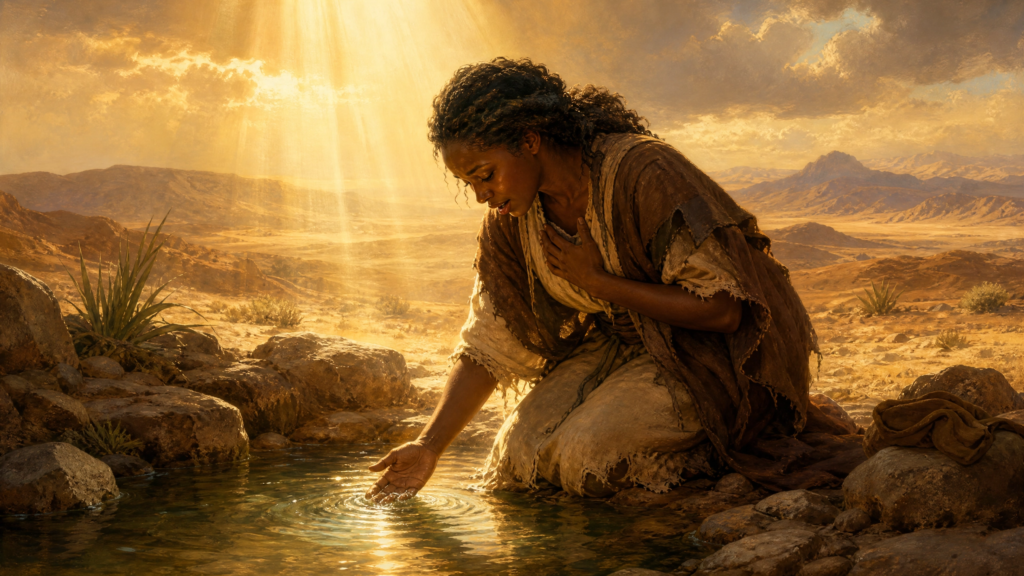
She had no power, no status, no choice. She was a slave — given away by one owner, used by another, and when she became inconvenient, driven out into the wilderness to die. By every measure of her world, Hagar was invisible.
But God saw her.
Genesis 16 tells us that when Hagar fled into the wilderness the first time, running from Sarai’s harsh treatment, the angel of the Lord found her by a spring of water. Found her — not by accident, not by chance, but with intention. He spoke to her, promised her that her son Ishmael would father a great nation, and sent her back with a word of hope she could hold onto.
And Hagar responded with one of the most remarkable declarations in all of Scripture. Genesis 16:13 — “You are the God who sees me.” She gave God a name. El Roi. The God who sees. No patriarch, no prophet, no priest had given God this name — a nameless Egyptian slave girl did, alone in the wilderness, because she had experienced something no theology could fully contain.
God had looked at the invisible woman and seen her completely.
But Hagar’s story doesn’t end there. Years later, after Isaac was born, she and Ishmael were cast out again — this time with no way back. She wandered in the wilderness of Beersheba until the water was gone, and then she laid her son under a bush, walked away, and wept. She could not bear to watch him die. Genesis 21:16.
And God heard the boy’s voice. An angel called to Hagar from Heaven — “What ails you, Hagar? Fear not.” And then God opened her eyes, and she saw a well of water.
It was there all along. God didn’t create it. He opened her eyes to it.
Friend, perhaps you are in a wilderness today. Perhaps you have laid down your hopes and walked away because you cannot bear to watch them die. El Roi sees you — right where you are, exactly as you are. And He may not change your circumstances immediately, but He will open your eyes to what is already there.
The God who saw Hagar sees you too.
In Jesus’ name, Amen.