
Boaz: Kindness That Redeems
Marcia Neveu
October 20, 2026

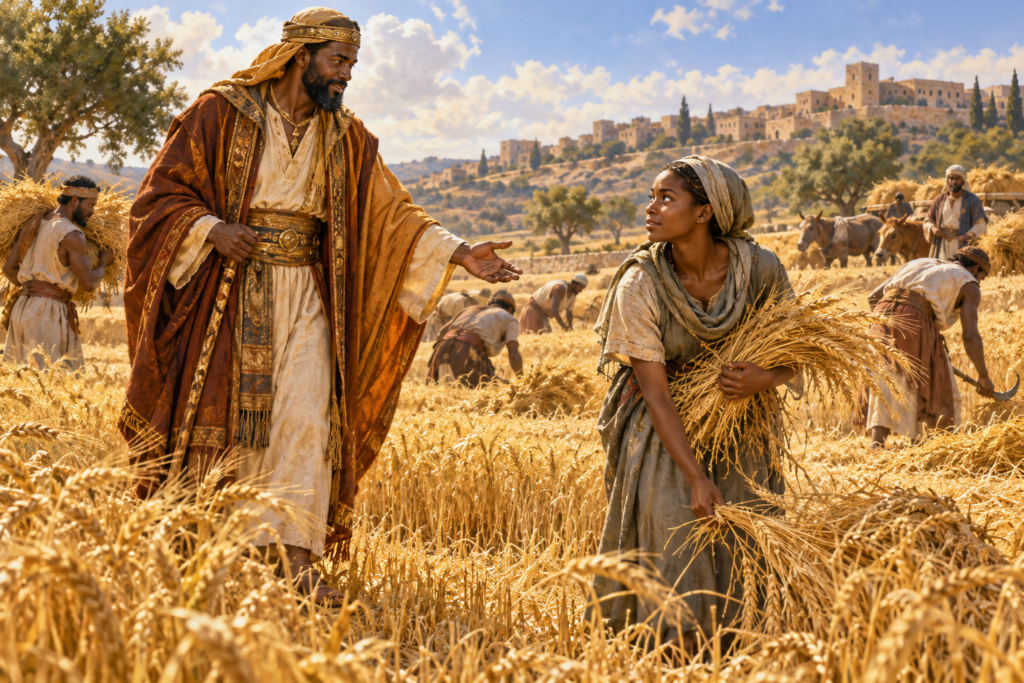
He owned the field. He owned the harvest. He owned more than most men in Bethlehem.
But what made Boaz worth a chapter in the lineage of Christ was not what he owned.
It was the way he stooped.
When Ruth came onto his land — a foreign widow gleaning the corners of someone else’s field — she was completely vulnerable. Moabite. Husbandless. Penniless. In any other landowner’s hands she could have been ignored, exploited, or chased off. Boaz did the opposite. He spoke kindly to her. He told his workers to leave extra sheaves for her on purpose. He invited her to eat at his table. And he prayed a blessing over her: “The LORD repay your work, and a full reward be given you by the LORD God of Israel, under whose wings you have come for refuge” (Ruth 2:12, NKJV).
The wealthy landowner stooped.
That stooping was no small thing. Under Israel’s law, when a woman was left without a husband and an inheritance, the closest male relative could redeem her — buy back her family land, marry her, and continue her dead husband’s line. It was called being the kinsman-redeemer. And it was costly. The redeemer paid out of his own pocket for what was not his to fix.
When the nearer kinsman refused to do it, Boaz stepped forward without hesitation. He redeemed the land. He took Ruth as his wife. He raised up the name of the dead in the inheritance. And the child born of that marriage was named Obed — the grandfather of King David and an ancestor of the line that would carry the Messiah.
A foreign widow. A redeeming landowner. A child no one could have predicted. The Holy Spirit was writing a story far bigger than any of them could see.
Hear me, friend. We serve a Kinsman-Redeemer who is greater than Boaz. Jesus Christ stooped from heaven to a manger, and from a manger to a cross, to redeem what we could never have redeemed for ourselves. He paid out of His own pocket for what was not His to fix.
And He is still asking us, His people, to do the same — to stoop. To leave the extra sheaves. To speak kindly. To carry redemption into the field of someone else’s brokenness.
Stoop in His name today. You may be writing a chapter you cannot yet see.